

In order to know what a reverse 1031 exchange is, we’ll have to review how a traditional 1031 exchange works.
In a traditional 1031 exchange, you engage with a qualified intermediary to sell your current property and then park the proceeds from that property into the next one. Read our complete 1031 exchange guide for the full walkthrough.
With a reverse 1031 exchange, you buy the replacement property first and then sell the old one later. But what are the rules? How does it work? What do you need to know to do a reverse 1031 exchange successfully?
That’s what we’ll cover in today’s article.
Last Updated: June 30th, 2026
Key Takeaways
- ▸A reverse 1031 exchange lets an investor buy the replacement property first and sell the old one later, while still deferring capital gains tax.
- ▸A neutral third party (the Exchange Accommodation Titleholder, or EAT) holds title to one property so the investor never owns both at once, and the whole transaction must close within 180 days.
- ▸It costs more than a standard exchange, but on a large deferred gain the math generally favors it.
What Is a Reverse 1031 Exchange?
A reverse 1031 exchange is a tax deferral structure that reverses the usual order of a like kind exchange: the investor acquires the replacement property before selling the relinquished one. Because the IRS does not allow a taxpayer to hold title to both properties at the same time inside an exchange, a neutral third party temporarily “parks” one of them until the sale closes.
The legal footing comes from IRS Revenue Procedure 2000-37, issued in September 2000, which created a safe harbor for these parking arrangements. Before that guidance, reverse exchanges lived in a gray area built on private rulings and court decisions, which is part of why they were considered risky. Under the safe harbor, an Exchange Accommodation Titleholder (EAT), usually a single member limited liability company formed for the purpose, takes legal title to one property and is treated as its owner for federal tax purposes while the exchange is completed, as IPX1031 explains.
A Qualified Intermediary (QI), the same neutral party used in a standard exchange, coordinates the documents and the funds and typically sets up the EAT. The underlying rules remain stable: recent federal tax legislation, including the One Big Beautiful Bill Act (OBBBA), left Section 1031 intact, and since the Tax Cuts and Jobs Act (TCJA) the provision applies to real property only. For the mechanics a reverse exchange builds on, our 1031 exchange guide covers the fundamentals in full.

When Does a Reverse 1031 Exchange Make Sense?
A reverse 1031 exchange makes the most sense when the replacement property is the constraint, not the sale. In competitive, low inventory markets, a strong asset can disappear before a buyer for the current property closes, and a reverse structure lets an investor lock in the purchase first rather than lose it to timing.
A few situations tend to call for it. The clearest is finding an ideal replacement property that may sell quickly to someone else. Another is wanting to keep the purchase from being held hostage to an uncertain sale, since financing fallout, tenant lease issues, or a buyer’s contingencies can all delay a closing. A reverse exchange also supports build to suit timing, where work on the parked property can begin while it is held rather than waiting until the relinquished property sells.
Because the best net lease deals are often sourced off market and never publicly listed, the replacement side is frequently where the pressure builds in the first place. Custom Capital sources and pre vets off market deals, which can ease that crunch before it forces an investor into a more complex structure. For more on why the strongest inventory stays out of public view, see our overview of how to find off market NNN properties.
How a Reverse 1031 Exchange Works, Step by Step
The sequence is the inverse of a forward exchange, but the goal is to make the transaction appear in the proper order to the IRS. Here is how a typical reverse 1031 exchange unfolds.
Engage a Qualified Intermediary
The investor engages a Qualified Intermediary before signing any purchase agreement for the replacement property. The QI coordinates the documents and the funds and sets up the parking structure.
Set Up the QEAA
The QI puts the Qualified Exchange Accommodation Arrangement (QEAA) in place, the written contract that governs the parking structure. It generally must be signed within five business days of the EAT taking title.
Park the Property With the EAT
The EAT acquires and parks the property. There are two common approaches: in an “exchange last” structure, the replacement property is parked (the more common path), while in an “exchange first” structure, the relinquished property is parked instead, as First American Exchange describes.
Fund the Purchase
Since the sale has not happened yet, the purchase cannot run on proceeds that do not exist, so the money comes from a loan by the investor or a third party bridge or bank loan. While the property is parked, it can be leased back to the investor, who can then collect rent from tenants, according to Northmarq.
Sell the Relinquished Property
The investor sells the relinquished property within the exchange window, with the proceeds running through the QI to repay the loan used for the early purchase.
Complete and Report the Exchange
The EAT transfers title (or the membership interest in the single member limited liability company) to the investor, and the exchange is reported on IRS Form 8824 for the tax year the relinquished property was sold.
Illustrative scenario:
Say an investor finds a $1M replacement property before selling a $1M asset. On Day 0, the EAT acquires the replacement and parks it, funded by a bridge loan. Within 45 days, the investor identifies the property to be sold. Around Day 150, the relinquished property sells, the proceeds repay the bridge loan through the QI, and the EAT transfers title before Day 180, completing the exchange.
The 45-Day and 180-Day Deadlines in a Reverse Exchange
In a reverse 1031 exchange, the clock starts when the EAT acquires the parked property (Day 0), not when anything sells. From there, the investor has 45 calendar days to identify the relinquished property in writing and 180 calendar days to complete the entire exchange.
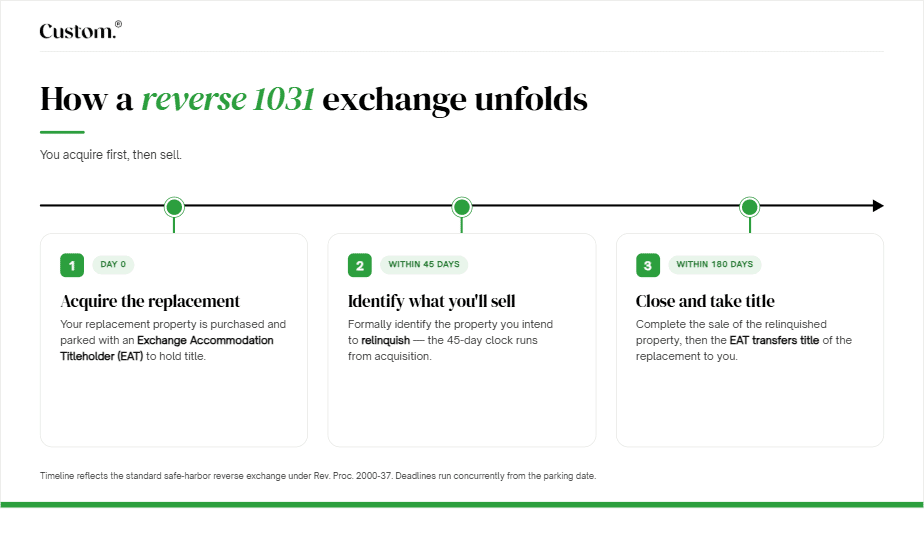
These windows mirror the same 45 and 180 day deadlines covered in our 1031 exchange guide, just with a different trigger. They are measured in calendar days, with no extensions for weekends, holidays, or difficult market conditions. The written identification must follow one of the three standard rules (the three property rule, the 200% rule, or the 95% rule), though in most reverse exchanges the investor already knows which property they intend to sell, so identification is generally straightforward.
The harder part is usually selling within 180 days, which is why a realistic sale plan matters before parking anything. One technical note worth flagging: the 180 day parking period under Revenue Procedure 2000-37 and the 180 day exchange period under Section 1031 run as separate requirements, so the structure has to satisfy both rather than treat them as one.
What Does a Reverse 1031 Exchange Cost?
A reverse 1031 exchange typically runs $5,000 to $15,000 or more in QI and EAT fees, compared with roughly $750 to $1,500 for a standard forward exchange. Bridge financing, dual carrying costs, and legal fees push the all in figure higher.
The components add up across several line items: QI and EAT setup fees plus monthly holding fees while the property is parked, interest on the bridge or hard money loan used to fund the early purchase (commonly in the 8% to 12% range), and double carrying costs during the overlap (property taxes, insurance, and potentially two sets of loan payments). On top of that, a CPA generally charges to prepare Form 8824, and some states assess transfer taxes when title moves to and from the EAT.
The way to judge the cost is against the tax being deferred. For 2026, long term capital gains top out at 20% for high earners, and many investors also owe the 3.8% Net Investment Income Tax (NIIT) plus depreciation recapture taxed at up to 25%. On a $500,000 gain, the combined federal exposure can run well into six figures, which generally dwarfs even a $15,000 structuring cost. Those fees matter, but for a sizable gain they tend to be a rounding error against the deferral.

Reverse vs Forward 1031 Exchange: Which Makes More Sense?
It is worth being honest about the appeal of the standard route first. A forward exchange is simpler and cheaper: no parking entity, no bridge financing, fewer moving parts, and a fee that is often under $1,500. For most investors who can comfortably sell before they buy, the forward exchange is the better default.
That said, a reverse 1031 exchange earns its added cost in the specific case where the replacement opportunity is genuinely at risk. In a tight market, it is frequently easier to find a buyer for a property already owned than to find the right replacement, which is what tilts the decision toward buying first. The reverse structure also provides sale certainty, since the acquisition is locked in before the disposition begins.
So the practical guidance is this: when selling first is realistic, take the simpler and cheaper forward path. When the replacement is the scarce piece and the deferred gain is large enough to absorb the extra cost, a reverse 1031 exchange is generally worth the added complexity.
Choosing a Strong Replacement Property for a Reverse Exchange
The structure is only as good as the asset it lands on. Because a reverse exchange front loads cost and financing, the replacement should be something an investor is comfortable holding for the long run, not a property chosen under deadline pressure. For many accredited investors, single tenant absolute triple net (NNN, a lease in which the tenant covers taxes, insurance, and maintenance, leaving the owner with low, ongoing responsibilities) fits that brief: predictable income, an income producing hard asset, and limited day to day work. Our piece on why NNN properties are the ideal 1031 replacement makes the full case. The market is moving the same way, with reporting through early 2026 showing investors shifting toward passive replacements such as NNN properties and Delaware Statutory Trusts (DSTs).
Two practical points are specific to the reverse structure. First, sourcing: the inventory crunch that pushes investors toward reverse exchanges is the same crunch that makes off market access valuable, since the strongest net lease deals are typically vetted in advance and never publicly listed. Second, financing: because a reverse exchange usually requires funding the purchase before the sale closes, access to institutional financing terms matters more than usual. Custom Capital’s model pairs off market, pre vetted inventory with a programmatic institutional lending facility (institutional terms made available to individual investors), which speaks to both pressure points. Our process overview walks through how the sourcing, due diligence, and financing pieces fit together.
The Bottom Line: Is a Reverse 1031 Exchange Worth It?
A reverse 1031 exchange comes down to a simple sequence with exacting rules: buy first, park one property with an EAT, and sell within 180 days, all while deferring the same capital gains tax a forward exchange would. It costs more, so it is not the right tool for every situation. Where it shines is when the replacement property is the scarce piece, the timing will not wait, and the deferred gain is large enough that the extra fees barely move the needle.
For anyone weighing one, the deadlines do not bend and the documentation is unforgiving, so the clearest next step is to schedule a call and talk through whether reverse or forward fits the situation, and which replacement property makes the deferral worthwhile.
This article is educational and is not tax or legal advice, so confirm the specifics with a CPA or tax attorney before structuring an exchange.
Thinking About a Reverse 1031 Exchange?
We can help you weigh reverse against forward and line up a pre vetted replacement property worth the deferral.
Custom Capital works with accredited investors.
Frequently Asked Questions
Can you buy a property before selling in a 1031 exchange?
Yes. That is precisely what a reverse 1031 exchange allows. An Exchange Accommodation Titleholder (EAT) parks one of the two properties so the investor never holds title to both at once, and the full transaction must be completed within 180 days under IRS Revenue Procedure 2000-37.
How long do you have to complete a reverse 1031 exchange?
The investor has 45 calendar days to identify the relinquished property in writing and 180 calendar days to complete the entire exchange. Both clocks start on Day 0, the date the EAT acquires the parked property, and there are no extensions for weekends, holidays, or market conditions.
Do you need a qualified intermediary for a reverse exchange?
Yes. A reverse exchange requires both a Qualified Intermediary (QI), which coordinates the documents and funds, and an Exchange Accommodation Titleholder (EAT), which temporarily holds title to one property. The QI typically sets up and manages the EAT on the investor’s behalf.
Can you finance the replacement property in a reverse exchange?
Yes, and financing is usually required, since the sale proceeds are not yet available to fund the purchase. Most investors use a bridge loan, a bank loan, or a loan to the EAT, and the parked property can generally be leased back to the investor to generate rent during the holding period.
Is a reverse 1031 exchange more expensive than a regular one?
Generally yes. QI and EAT fees for a reverse exchange typically run $5,000 to $15,000 or more, versus roughly $750 to $1,500 for a standard forward exchange, before adding bridge loan interest and dual carrying costs. On a large deferred gain, though, those costs are usually small relative to the tax savings.