

If you’re searching for “passive real estate without syndication,” then chances are you’ve already allocated significant capital into a syndication.
Syndications are a natural first option for accredited real estate investors looking for passive income. You don’t have to do any of the maintenance yourself. You sign away a $100k, $200k, or $500k+ check to someone you trust and hope that they can deliver their targeted returns within whatever time frame they’ve selected.
The only problem is: That sometimes just doesn’t happen.
In this article, we’ll cover the definition of passive income. We’ll look at why accredited investors are largely turning away from syndications and present a reasonable alternative that still focuses on 100% ownership, and we’ll even admit when syndications are a better option.
Key Takeaways
- ▸Owning a single tenant net lease building outright, with the tenant covering taxes, insurance, and upkeep. While 100% ownership isn’t necessarily 100% passive, this is a great option that many investors who are looking for passive returns don’t consider.
- ▸You cannot 1031 into most syndications.
- ▸When you own 100% of a building, you don’t have to worry about capital calls or complete illiquidity. You have the option to sell a CRE building whenever you want.
- ▸Syndications can still be a good option for some buyers.
What Does Passive Real Estate Mean?
Passive real estate might sound, at first, like an oxymoron. How could owning a building that you have to maintain and lease out be passive?
Most investors realize that direct real estate ownership will involve some level of active participation. If you own a single family rental down the road, chances are that even if it was completely gutted and reno’d before you rented it out, you’re going to get a phone call from your tenant complaining about something.
When that happens, you’re going to have to make the difficult decision to do the work yourself or hire someone out. While hiring someone seems like the more “passive” option, it still means you have to pick up the phone, evaluate contractors, choose one, pay them, and make sure the work was solid. That’s where syndications come in.
A syndication is is a partnership model where multiple investors pool their money to buy, manage, and sell a large property.
As we’ve mentioned, if you’re on this page, you’re already looking for ways that you can make passive income in real estate without having to buy into a syndication.
In our opinion, buyers have four routes to passive income: owning net lease outright, a Delaware Statutory Trust, a public REIT, or a net lease fund.
A Brief History of Why Some Investors Are Turning Away from Syndications
In 2021 and 2022, many syndication operators ran into trouble. Interest rates were floating around the zero percent mark and the economy was flush with cash from all the stimulus. This created a unique buying opportunity for many operators, and buy they did: In 2021, global commercial real estate (CRE) purchases hit a record $1.3 trillion, while U.S. CRE acquisitions alone accounted for an all-time high of $809 billion.
In hindsight, it’s easy to look back and think it was insane to buy up deals like kids at a candy store, but many experienced operators were simply following the Fed’s guidance at the time:
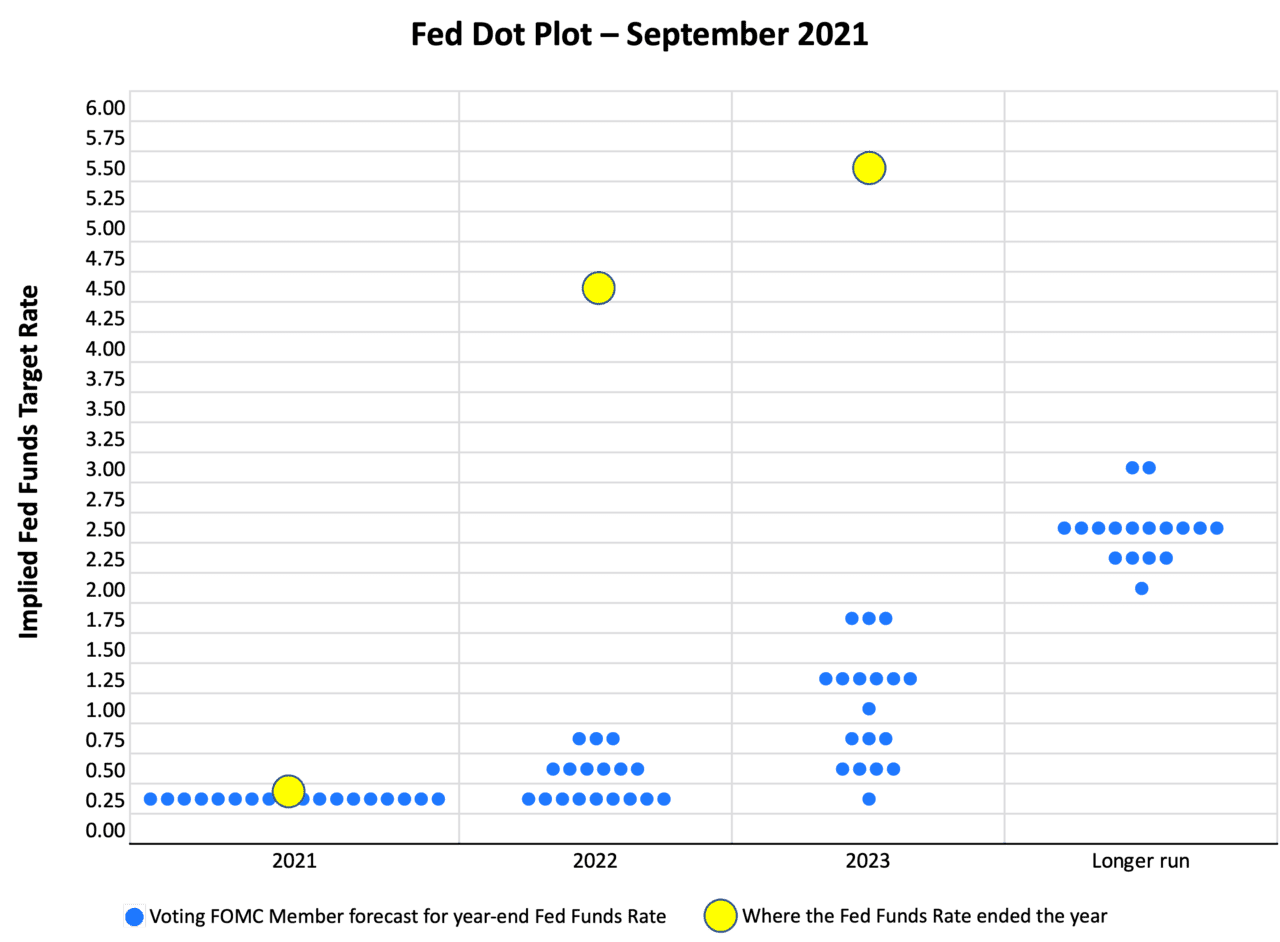
As you can see above from the September 2021 FOMC meeting, the dot plot shows that the US government’s foremost economic experts projected small 0.25-0.5% interest rate increases through 2022, 2023, and beyond. In fact, 0 out of 18 officials expected a rate hike. The yellow markers on that plot, though, show what actually happened: interest rates increased 2-5%+ more than what the Federal Reserve’s experts expected. If you look back on that data, even the most pessimistic projections for 2024 were off by more than 2.5%.
But those optimistic projections are what syndication operators had underwritten their deals with. When they were writing out their business plans, they weren’t expecting to refinance with mortgage rates in the 6.5-8% range; they were expecting 3-5%.
You can imagine what that does to cash-on-cash returns.
In the short term, nothing changed. The operators were mostly on 5-year fixed loans. To some extent, “extend and pretend” is very alive today. However, as the years march on and operators’ business plans require financial restructuring, many of those deals need rescue capital calls or paused payouts.
Capital calls in particular catch many investors off-guard. When you’re initially pitched on syndication investing, a capital call is an afterthought. It might not even be mentioned. The gist is that the deal is going to go well. You’re going to get paid. You don’t have to worry about it.
In reality, the operator can come ask you for more money — and if you say no, your stake can shrink. Your “passive income” deal doesn’t look too good anymore.
Paused payouts create a different headache. Maybe you invested for a 5-year expected return and now it’s year 10 but you still haven’t gotten your principal back. When are you going to get paid back, if ever? Who knows?
However, it should be noted that none of this makes syndications bad. It does explain, however, why some of them have underperformed and why some investors are interested in looking for an alternative.
For anyone still weighing an offer, our guide on what to check before joining a syndication walks through the terms that matter.
How NNN Leases Deliver Passive Real Estate Without Syndication
Absolute NNN (triple net) leases push taxes, building insurance, and upkeep onto the tenant. A corporate or franchise operator signs a lease that often runs 5 to 20 years. They occupy the space, maintain it, and pay rent each month. The owner’s total responsibilities therefore stay low (so it’s more passive than many other options) but they’re never quite zero.
If you’re an investor who’s looking for commercial real estate exposure without investing in a syndication, this is one of your best bets. With a reliable tenant paying much of the maintenance on the property, you won’t have to worry about doing it yourself.
The problem, though, is finding deals that are worth buying. That’s where we come in…
Direct Ownership vs. DSTs vs. REITs
The other options for passive ownership include DSTs and REITs.
Delaware Statutory Trusts. A DST holds title and sells fractional stakes. The IRS treats those stakes as like kind property under Revenue Ruling 2004-86, so DSTs help when a 1031 clock is running. The catch is rigidity. To keep that tax status, a DST cannot take new money after closing, cannot refinance, and cannot reinvest sale proceeds. If the roof fails, the trust pays out of cash on hand.
Public REITs. REITs offer liquidity and breadth the other two cannot match. What they do not offer is depreciation passed through to you, 1031 access, or shelter from stock market swings. A REIT share trades like a stock because it is one.
What Owning Outright Gives That an LP Stake Cannot
While DSTs and REITs can be decent options, there are a lot of reasons why 100% direct ownership can be a better option.
Control over timing. You pick when to refinance, when to sell, and how long to hold. No sponsor sets the clock, and no capital call shows up out of the blue.
The whole depreciation schedule. Direct owners write off 100% of the improvement basis, not a small slice. The cost segregation call is yours too. The One Big Beautiful Bill Act made 100% bonus depreciation permanent for property bought after January 19, 2025, which the IRS confirmed in Notice 2026-11. Our piece on the restored bonus depreciation rules for NNN covers the mechanics.
A 1031 at exit. This is the biggest gap, and many buyers learn it too late. Federal rules state that Section 1031 does not apply to any swap of partnership interests, general or limited. The partnership can run a 1031 at the entity level. Still, a single partner usually cannot roll their own stake into a new building. Direct owners can, and they can do it again. Our 1031 exchange guide explains the timeline.
No promote. A common 2026 deal pays partners a preferred return, then splits profits with the sponsor above set hurdles. That split pays for the sponsor’s work, and it is fair in context. It is also a lasting claim on your return that direct ownership avoids.
Illustrative scenario:
Say a buyer sells an apartment building and clears $2 million after paying off debt, with roughly $700,000 of gain in play.
Put into a syndication, that $2 million buys an LP stake. When the sponsor sells in year six, the stake cannot be swapped. The gain is usually taxed and the bill comes due.
Put into an NNN building owned outright, the same $2 million funds a 1031. The gain rolls into the new basis, rent arrives from a single tenant lease, and the option to swap again stays open at the next sale.
This example is for illustration only and reflects no specific deal. Tax results vary. Please consult your own tax advisor.
When Does a Syndication Still Make Sense?
Owning outright is not the answer for everyone. Pretending otherwise would be dishonest.
Check size is the top reason to pool. A quality single tenant asset often needs $1 million or more in equity. Syndications take far smaller checks, which lets a buyer build up slowly.
Spreading risk is the second reason. One building with one tenant is a focused bet. If that tenant fails, income stops until you re lease the space. A partner spread across several deals absorbs one loss more easily.
Strategy is the third. Net lease income is steady, not explosive. Buyers who want value add returns, ground up building, or a turnaround story will not find them in a stabilized NNN asset. A good sponsor is the practical way in.
Lastly, some people simply want a pro making the calls. That is a fair preference, not a compromise.
What Owning Outright Actually Requires
The honest tradeoff here is not management. It is the buy itself. Finding a well placed building with a credit tenant is hard work. So is vetting the lease and the guarantor, lining up debt, and closing inside a 1031 window. That difficulty is why so many buyers pool instead.
Sourcing is the hardest part. High grade assets make up under 10% of retail stock for sale, so the good ones rarely hit public listing sites. They move through relationships.
Debt is the second hurdle. One buyer shopping a single loan usually gets worse terms than a firm placing many. Custom Capital solves this with a programmatic lending facility, meaning pre approved terms that hand one buyer the pricing a large firm would expect. It is a standing facility, not a list of contacts.
This is the gap a private family office fills. Custom Capital handles sourcing, diligence, and financing so you review a vetted deal and take title. To date the firm has closed more than $460 million across 125 or more deals, backed by a 50 person team in 7 divisions.
You still own the asset outright. The work of getting there is simply handled for you.
Final Thoughts: Choosing the Right Passive Structure
Passive real estate without syndication is a genuine option. For buyers who care about control and taxes, it tends to be the stronger one. Owning outright keeps the whole depreciation schedule, keeps a 1031 open at exit, and drops both the promote and the risk of a capital call.
That said, pooled deals remain a smart pick for smaller checks, wider spread, or plans that need an active operator. The right setup depends on capital, timeline, and how much control matters to you.
For anyone weighing the two, the best next step is usually a talk about real numbers rather than more reading.
See What Direct Ownership Looks Like for Your Capital
Custom Capital sources, vets, and finances single tenant NNN assets so accredited buyers own 100% of the building without running it.
For accredited investors only. Nothing here is an offer to sell or a solicitation to buy any security.
Frequently Asked Questions
Is direct NNN ownership truly passive?
Absolute NNN leases hand taxes, insurance, and upkeep to the tenant, which keeps the owner’s duties low. It is not zero effort. You still hold the asset, watch tenant credit, and make calls at lease end or sale. Most owners call it hands off in practice rather than fully automatic.
Can a limited partner in a syndication do a 1031 exchange?
Usually no. Federal rules bar swaps of partnership interests from Section 1031, whether general or limited. The partnership itself can run an exchange at the entity level. Some sponsors try a drop and swap, though those setups draw IRS scrutiny and rarely go smoothly.
How much capital does a direct net lease purchase require?
It varies with asset type, tenant credit, and debt terms. Quality single tenant buildings often need $1 million or more in equity, though the figure moves with cap rates and loan pricing. Buyers with less capital tend to use a DST or a syndication.
What are current cap rates for single tenant net lease properties?
Single tenant net lease cap rates averaged 6.82% in the second quarter of 2026, per The Boulder Group. Retail sat at 6.60%, industrial at 7.25%, and office at 7.90%. Pricing swings widely based on tenant credit and years left on the lease.
Is a DST the same as a syndication?
No. A DST is a trust that holds title and issues fractional stakes, which the IRS treats as like kind property for 1031 use under Revenue Ruling 2004-86. A syndication is usually an LLC or limited partnership, and its interests do not qualify for a 1031.