

Since inception, Custom Capital has helped its family office members acquire over $400 million in commercial real estate. In 2025 alone, that number exceeded $200 million, deployed across a range of asset classes, geographies, and tenant profiles.
One of the most common questions we get from new investors is simple: Where is everyone else investing?
We won’t share specific deal details or individual investor information, but we’ve compiled a high-level summary of our top asset classes in 2025. The breakdown might surprise you, or it might confirm exactly what you suspected.
Where Custom Capital Members Deployed Capital in 2025
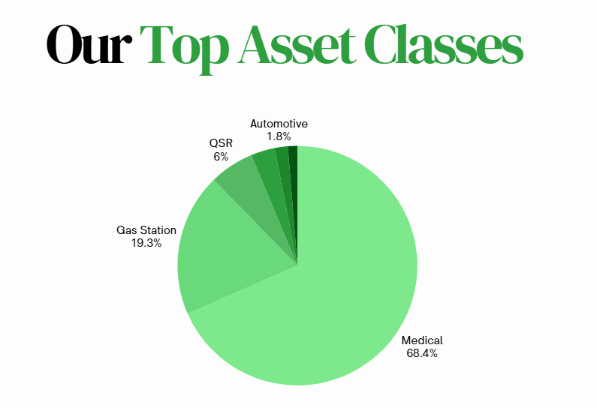
Medical real estate led the way by a wide margin, followed by gas station assets and quick-service restaurants. Mixed-use, automotive, and car wash properties rounded out the portfolio.
Here’s a closer look at the top three.
#1 Most Popular Asset Class: Medical Real Estate ($138M+)
Medical real estate was, by a significant margin, the most popular asset class among Custom Capital investors in 2025.
To understand why, here’s an example: A dermatology practice that’s been in the same medical office building for 14 years has $400,000 of specialized equipment built into the walls, 8,000 patients who know exactly where to find it, and a referral network that took a decade to build. Moving is financially irrational. Medical tenants can’t simply relocate. Their patient base is location-dependent, their buildout costs are massive, and their referral relationships are hyperlocal.
That’s what makes medical real estate compelling beyond the headline demographics. Yes, the aging population creates a multi-decade demand tailwind: over 4 million Baby Boomers will turn 80 in the next five years, and adults 65+ will represent roughly 20% of the U.S. population by 2030. But the structural “stickiness” of medical tenants means that at renewal time, landlords aren’t competing with every other building in town. They’re negotiating with a tenant whose cost of leaving often exceeds the cost of staying.
Long lease terms, NNN structures, and demographic alignment made medical real estate the clear #1 in 2025.
Want to go deeper? Read our full Medical Real Estate Whitepaper →
#2 Gas Station Real Estate ($39M+)
Gas station assets came in second, resulting in nearly $40M of transaction volume.
Americans drove a record 3.28 trillion vehicle-miles in 2024, hitting a new record. Then, in 2025, Americans drove 3.32 trillion vehicle-miles, topping it. About 279 million vehicles are registered in the U.S., roughly one per adult, and 92% of American households own at least one car. The demand for fuel is structural tied to a society that has built its commuting, commerce, and daily life around personal vehicles.
Beyond demand fundamentals, gas station real estate offers meaningful tax advantages. Many properties qualify as “retail motor fuel outlets” under IRS rules, allowing the building and improvements to be depreciated over 15 years instead of the standard 39. Cost segregation studies frequently find that 50–80% of a gas station’s depreciable basis qualifies for accelerated depreciation.
Long NNN leases (often 15–20 years), minimal landlord management responsibilities, and the ongoing consolidation of the industry toward larger, more creditworthy tenants made gas station real estate a top performer in 2025.
Read our full Gas Station Real Estate Whitepaper →
#3 Quick-Service Restaurants ($12M+)
Quick-Service Restaurant properties (think national and regional fast-food brands operating under long-term, corporate-guaranteed leases) rounded out the top three. Like gas stations, QSR assets are typically structured as absolute NNN properties, meaning the tenant is responsible for taxes, insurance, and maintenance. The landlord collects rent with minimal day-to-day involvement.
Drive-through volumes have remained resilient across economic cycles, and long lease terms, often 15–20 years with renewal options, provide the kind of cash flow durability that income-focused investors seek.
QSR properties also tend to occupy high-visibility, high-traffic locations with strong underlying land values, which supports asset value even in softer market conditions.
Where Members Deployed Capital Geographically
Beyond asset class, geography played a significant role in where investors allocated capital in 2025. Texas led all states by a wide margin, followed by Arizona, Nevada, Florida, and Ohio.
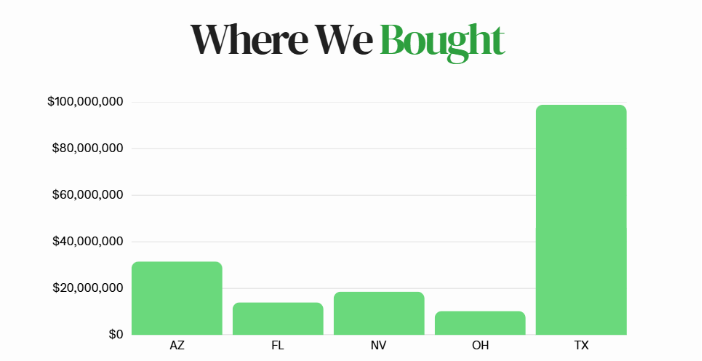
The concentration in Sun Belt states reflects a familiar thesis: population growth, business-friendly regulatory environments, and strong demographic tailwinds continue to drive commercial real estate demand in these markets.
What This Tells You
The through-line across Custom Capital’s top asset classes in 2025 isn’t complicated: our investors favored properties anchored by non-discretionary demand, structured under long NNN leases, with tenants who have strong economic reasons to stay.
Medical tenants can’t easily leave. Gas station operators serve a daily necessity. QSR brands occupy prime real estate with corporate backing. These aren’t exciting, speculative bets — they’re methodical allocations into assets designed to generate durable, long-duration income.
That’s the family office approach: Building infrastructure that compounds over time.
Interested in learning how Custom Capital’s family office model works for investors like you? Get in touch with our team.