

The world’s 500 richest people added a record $2.2T to their fortunes in 2025. That brought their combined net worth to $11.9T, per the Bloomberg Billionaires Index (as of December 31, 2025).
In this article, we’ll cover what a private family office is and which billionaire offices are the largest. Then we’ll take a look at why these offices allocate so much money to real estate in particular. Finally, we’ll explain how Custom Capital brings this same model to average, everyday accredited investors who have the capital but not the time to invest in commercial real estate.
Key Takeaways
- ▸Family offices exist to protect wealth, and real estate is one of their favorite tools for doing so.
- ▸Real estate often offers investors steady income and unique tax breaks (through the 1031 and stepped up basis).
- ▸A traditional family office often calls for $100M or more in liquid wealth, but our model brings it to investors with much less money.
- ▸Custom Capital buys absolute NNN properties as a principal and sells each one to a single buyer who owns it 100%.
What Is a Private Family Office?
A private family office is a firm built to manage a wealthy family’s money, affairs, and long term plans. Deloitte Private estimates there were about 8,030 single family offices worldwide as of 2024. Together, they held about $3.1T in assets.
A family office often has its own investment team, accountants, attorneys, and support staff. All of them focus on one family (or, sometimes, in the case of a multi family office: a variety of families). Rarely, if ever, do they focus on many people at once. The goal is to grow and preserve the wealth that family has created. Think of the Rockefellers, the Walton family, and the Kennedys.
This setup typically makes sense for families with $100M to $250M or more in liquid net worth. As we mentioned above, a typical family office has its own investment team, accountants, support staff, and more. Payroll costs alone for a relatively small 6 person office could already run $1M to $2M or more. If you’re “only” managing $100M, it doesn’t really make sense to burn $1M a year trying to grow it.
In this article, we won’t do an incredibly deep dive into family offices though. For a closer look at the structure, see our complete guide to private family offices.
Single Family Office vs. Multi Family Office
A single family office, true to its name, is built for one family.
A multi family office, on the other hand, serves a group of families who share one team. Much like a syndication model, this allows them to share the costs. If you have five families with $20M to $50M net worths, this option can make a lot of sense.
Inside the World’s Largest Billionaire Family Offices
You’ve probably heard the term “family office,” but you probably don’t understand just how popular they are. Here’s a list of some of the world’s largest billionaire family offices:

Estimated assets under management. Family offices do not have to report their assets. Figures vary by source and date.
Beyond the company stock that built these fortunes, offices like these tend to hold hard assets. Common examples include real estate, farmland, and roads or utilities. That raises a fair question: why do family offices allocate so much money to real estate?
Why Do Family Offices Choose Real Estate?
U.S. family offices held about 18% of their portfolios in real estate, according to the UBS Global Family Office Report 2025.
Meanwhile, only about 7 to 10% of Americans even own real estate outside of their primary residences.
Obviously, the question that comes to mind is: “Why?” Why are private family offices allocating so much more to real estate compared to the average investor?
The reasoning is fairly simple: Real estate is often an income producing hard asset. Let’s tackle that in stages…
1) Income producing. Investors like to allocate money towards businesses and investments that actively generate income. The upside is obvious: if a share of a company costs $100 and pays dividends of $3 a year, you can hold for 33 years and receive 100% of your principal back (while the equity value of that stock, the initial $100, grows over time). All other investments that don’t fit that mold are called “nonproductive” or “nonyielding.” That doesn’t mean they’re useless; it just means that they’re more speculative in nature.
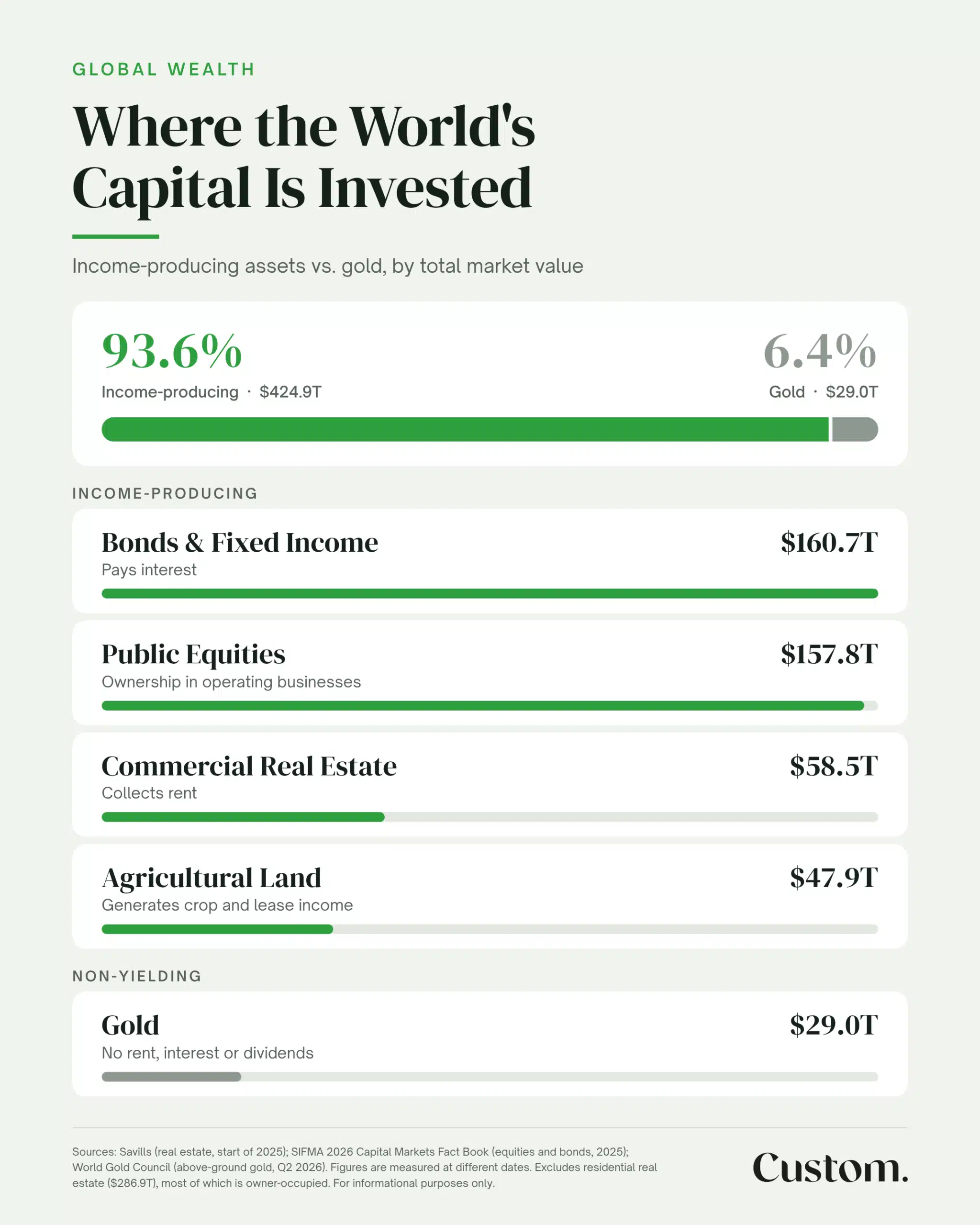
2) Hard assets. Unlike stocks and bonds, real estate physically exists. Therefore, it will always be inherently more valuable than paper, even if that paper is technically worth more. Put simply: You can live inside of a building, but you can’t live inside of a stock portfolio. Hard assets, while their upside may be more limited, are generally considered to be “safer” options for that reason, and hence they’re a great option for a family office that’s looking to preserve wealth.
The Third Reason: Tax Benefits
Finally, real estate offers something special that a lot of other asset classes do not: Tax benefits. One particularly important strategy for minimizing your effective tax bill and planning an estate transfer while incurring minimal taxes is the 1031 exchange, paired with something called the “stepped up basis,” which is explained below.
For the full rules and deadlines, see our complete guide to the 1031 exchange.
In plain terms, in a stepped up basis, the IRS resets the cost of the property to its market value at that time. If your grandfather purchased a property in 1961 for $10,000 and did multiple 1031 exchanges over time, eventually into a $6M multifamily property, if he went to sell it, he would be exposed to $5.99M of capital gains. You would inherit the property at a $6M basis, so you would be exposed to $0 in capital gains.
This is one legal way the wealthiest families may cut their tax bills by a wide margin. Still, the details depend on each family’s situation, so we recommend discussing how CRE can work into your overall plan with your CPA, who we would be more than happy to speak to during our calls, where we can review what CRE options we currently have available:
Learn More About Working with Custom Capital →
Why Has the Family Office Model Been Out of Reach for Most Investors?
A traditional single family office makes sense only for families with $100M or more in liquid wealth. Staffing one costs millions each year. For many accredited investors, though, time is the bigger barrier. In our experience, buying a commercial property can take roughly 20 hours a week of sourcing, underwriting, negotiating, and closing. That adds up to about 360 hours over the course of a single deal closing.
Without a team, accredited investors interested in commercial real estate have two obvious options:
Buying on their own. Many investors start here. The tradeoff is that the strongest properties don’t sit on the market for very long (or never go to market at all). A solo buyer also handles the diligence, legal work, and financing alone. This can be nearly impossible for someone working full time.
Joining a syndication. A syndication offers investors passive income, since a sponsor finds and runs the property. The tradeoff is that investors own a small, pooled share and have almost no say over what happens. Additionally, fees can cut into those returns, and sometimes those fees can be so exorbitant that there’s a clear incentive mismatch between the sponsor and the investor. We cover these tradeoffs in our article on what to know before investing in a real estate syndication.
The Third Option: Custom Capital
Most family offices serve ultra high net worth families (often those worth $30M or more). Custom Capital built its private family office for a different group: busy investors with cash on hand but little free time. They want the benefits of direct ownership without building a team of their own.
Custom Capital buys single tenant, absolute NNN and NN commercial properties as a principal. We then sell each property to one buyer, who owns 100% of it through their own entity. There is no pooling of capital across investors.
Absolute NNN leases generally shift property taxes, insurance, and upkeep to the tenant. As a result, landlord duties tend to be low, and income can start from month one. NN leases mean the landlord is responsible for roof and structure, but generally come with stronger tenants and guarantors (a tradeoff many investors are willing to make).
To date, Custom Capital has closed $470M+ in commercial real estate across 125+ deals in 15+ states. Our page on how the Custom Capital process works walks through each step.
Hear from Philip V., an accredited investor, on why this approach fit his situation.
Investor Perspective
Video not loading? Watch it on YouTube.
How Does Custom Capital Differ from a CRE Brokerage?
A commercial real estate brokerage acts as an agent. It represents a buyer or seller, earns a commission, and mostly works with listed properties. Custom Capital acts as a principal. It puts properties under contract in its own name and does the diligence first. Then it sells each one to a single buyer.
A broker’s job is to bring a buyer and seller together. The buyer still checks the property, arranges financing, and manages it after closing. Custom Capital, by contrast, holds the contract before a buyer ever reviews a property. So by the time a buyer decides, some of the hard work is already done.
The pay structure is also clear up front. Put simply: In exchange for handling sourcing, end to end transaction management, and closing for you, we mark up the property 6 to 10%. Our profit is built in to the price the buyer sees, and optional asset management carries its own fee. Our fees page breaks this down in full.
Custom Capital sells as a principal. It does not act as a broker, fiduciary, or investment adviser to the buyer. Each buyer should review a property with their own legal, tax, and financial advisors.
Is Family Office Real Estate Investment Right for Every Investor?
Not always. This approach tends to fit accredited investors who want direct ownership and steady income without doing everything themselves. It may not fit someone who needs quick access to cash or prefers many small positions. It may also not suit someone who dislikes holding a large share of wealth in one property.
Single tenant buildings carry a specific risk. If the tenant leaves or defaults, income from that property can stop until a new tenant moves in. Long leases and strong corporate guarantees can reduce that risk, but they cannot remove it. Commercial real estate is also illiquid, so a sale generally takes a while. It’s not quite as simple as hitting “Sell” on Vanguard (although that can be a good thing for some investors).
For investors comfortable with those tradeoffs, the appeal is clear. Owning 100% of an income producing property on a net lease can mean low landlord responsibilities while maintaining the option to defer gains through future 1031 exchanges. That mirrors how the wealthiest families have long approached real estate.
The Bottom Line: Family Office Real Estate Investment Without Building Your Own Family Office
The wealthiest families use family offices to protect what they have built. Real estate sits at the center of that plan. It offers steady income and the chance to defer capital gains. For decades, the team needed to invest this way served only families with $100M or more. Today, accredited investors can work with a private family office that buys as a principal. It then sells each property to a single owner.
Whether family office real estate investment fits a portfolio depends on goals, cash needs, and comfort with single tenant risk. To see if it fits yours, the clearest next step is to schedule a call with our team.
Put the Family Office Approach to Work
Talk with our team about your goals, your timeline, and whether 100% ownership of absolute NNN real estate fits your portfolio.
Frequently Asked Questions
What is the difference between a single family office and a multi family office?
A single family office serves one family alone. It has its own staff and full control over strategy. A multi family office serves a group of families who share one team. That spreads the cost. Iconiq, which serves a group of tech founders, is a well known example.
How much wealth does it take to start a family office?
A single family office has made sense for families with roughly $100M to $250M or more in liquid net worth. Its costs can run into the millions each year. Deloitte Private estimates there were about 8,030 single family offices worldwide as of 2024.
How much of a family office portfolio is typically in real estate?
It varies by region and by family. U.S. family offices held about 18% of their portfolios in real estate, per the UBS Global Family Office Report 2025. They held about 27% in private equity.
Do family offices invest in triple net properties?
Many do. Triple net leases shift property taxes, insurance, and upkeep to the tenant. That supports the steady income family offices tend to favor. Absolute NNN properties can also serve as replacements in a 1031 exchange, which IRS rules limit to real property held for business or investment.
How is Custom Capital compensated?
Custom Capital buys properties as a principal and earns a profit of 6 to 10%. That profit sits inside the price the buyer sees. There are no separate, ongoing, or back end fees. Optional asset management carries its own fee, and the Custom Capital fees page shows the full breakdown.