

Will a 1031 exchange cost you more money than it will save you?
If you’ve read our guide on the 1031 exchange, you know that a 1031 exchange can save you a lot of money. You’re able to completely defer the capital gains tax on real estate as long as you tightly follow the IRS’s rules.
But there’s one big factor that virtually no one in the 1031 space talks about: 1031 exchanges aren’t free.
There are filing fees, there are fees to hire a qualified intermediary, and there are risks that if the 1031 doesn’t pan out, you might be left with a far bigger tax bill than you ever expected.
In this article, we’re going to shine a light on all of that.
But first…
What is a 1031 Exchange?
As stated in our 1031 exchange guide, a 1031 exchange is a tax-saving tool that lets real estate investors delay paying capital gains taxes when they sell a property, as long as they reinvest the money into a similar property.
On our recent webinar, Marissa LoCascio of 1031Corp (not an affiliate link; just a trusted colleague) explains the process in-depth:
Video not loading? Watch it on YouTube.
Key Takeaways
- ▸A standard 1031 exchange typically costs $600 to $2,000 in qualified intermediary fees, based on published provider pricing in 2026.
- ▸Reverse and improvement exchanges cost more, often starting around $4,500 and reaching $10,000 or higher.
- ▸The largest potential cost is a failed exchange, which can turn a deferred gain into an immediate tax bill.
- ▸Boot (cash or debt relief received in the exchange) is taxable, even when the rest of the exchange succeeds.
How Much Does a 1031 Exchange Cost?
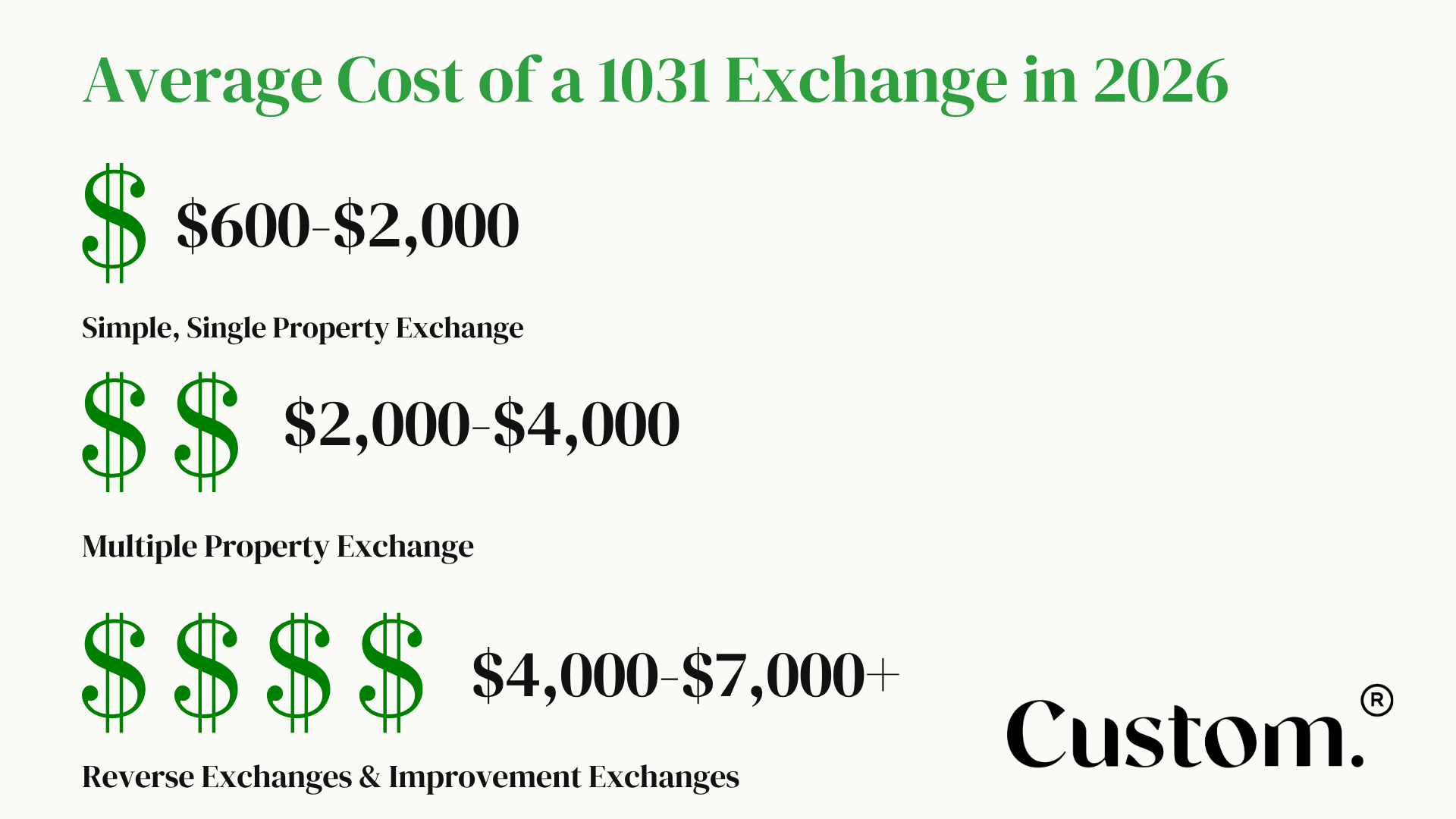
There are three fees associated with a 1031: 1) qualified intermediary fees, 2) the hidden cost of a 1031 failing, and 3) 1031 exchange boot.
Qualified Intermediary Fees
Looking through a number of providers’ websites, we find that average administrative prices for 1031 exchanges range from $600 to $2,000.
NOTICE: It should be noted that we here at Custom Capital do not provide 1031 qualified intermediary services.
Exchange Resource Group: $950+
Sera Capital: $600-$1,200
Universal Pacific 1031 $600-1,500
When engaging with a qualified intermediary, these upfront fees should not be one of your primary concerns. Even though (as you’ll see later), complicated 1031 exchanges could cost you up to $10,000 in fees, most investors consider these to be fairly negligible in the grand scheme of their exchange.
Here’s why…
The Hidden Cost of Failing a 1031 Exchange
The IRS is very strict about deadlines. If you fail your 1031 exchange, you don’t have any wiggle room to fix it.
Illustrative scenario:
An investor sells a property for $1.2 million. It carries no mortgage. The adjusted basis is $400,000, which reflects $200,000 of depreciation taken over the years. That leaves an $800,000 gain. The plan is to trade up into a $2.4 million NNN property, using the full $1.2 million as a down payment.
Now suppose the purchase falls through on day 170, and no backup property closes in time. The exchange fails. At top 2026 federal rates, and assuming other income already exceeds the surtax threshold, the bill could be insanely expensive. First, the $200,000 of depreciation is taxed at up to 25%, or $50,000. Next, the remaining $600,000 is taxed at 20%, or $120,000. Finally, the 3.8% net investment income tax on $800,000 adds $30,400.
That totals about $200,400 in federal tax, before any state income tax. On top of that, the investor now has roughly $1 million to reinvest instead of $1.2 million. At the same 50% loan to value, the target property shrinks from $2.4 million to about $2 million.
The rates in this example come from current federal rules. Kiplinger’s 2026 capital gains overview explains the 25% rate on unrecaptured depreciation and the 3.8% surtax thresholds. However, we’re making a lot of assumptions here. Actual results depend on income, filing status, and state of residence.
Put simply: The QI fee should be considered negligible if you’re dealing with a serious amount of capital. It is usually the smallest line item in a 1031 exchange. The largest potential cost is a missed deadline, which can cause a tax bill in the hundreds of thousands of dollars.
Compare that $200,400 to a $1,000 intermediary fee, and the priorities become clear. Most failed exchanges trace back to a few avoidable mistakes:
Touching the proceeds. If sale funds land in the investor’s own account, even briefly, the exchange generally fails.
Naming only one property. A single identified property leaves no fallback if that deal collapses. The IRS rules allow backups, and most investors use them.
Waiting on financing. A loan that closes late can push the purchase past day 180.
This is one reason we focus on planning early. Our investment process pairs vetted, off market NNN properties with a programmatic institutional lending facility. That combination can help exchange buyers move within tight IRS windows.
Talk Through Your Exchange Timeline →
1031 Exchange Boot
Additionally, there’s another cost associated with 1031 exchanges: boot.
Boot is any cash or non like kind property an investor receives in an exchange. The IRS taxes gains up to the value of that boot, even when the rest of the exchange qualifies, according to its real estate tax tips on like-kind exchanges.
Boot usually takes one of two forms…
Cash boot. This happens when the replacement costs less than the property sold, or the investor keeps some of the proceeds. For example, selling a property for $1.2 million and buying another property for $1.1 million generally leaves $100,000 of taxable boot. It’s not “like-kind” if you aren’t trading up.
Mortgage boot. Debt relief counts too. Say an investor pays off a $500,000 loan on the old property but takes only a $400,000 loan on the new one. The $100,000 difference is generally treated as boot, unless the investor adds cash to cover the gap.
To fully defer tax, investors generally need to meet three tests. According to The Real Estate CPA’s 1031 guide: they should: 1) buy property of equal or greater value, 2) reinvest all net proceeds, and 3) replace any debt paid off.
For some investors, boot is not always a mistake. Some investors take a small amount on purpose because they want some cash on hand.
The key is knowing that this will cost them on their tax bill. You need to be able to plan accordingly.
Other Fees
Beyond the intermediary fee, several other costs tend to show up. Many are normal closing costs that any sale or purchase would carry, but it’s good to keep them in mind regardless:
Closing costs. Title insurance, escrow, recording, and transfer taxes still apply even when you’re doing a 1031 exchange. It might seem like common sense, but many investors think that closing costs will vary just because they’re doing a 1031. That is not true. Additionally, transfer taxes vary widely by state and county, and in some areas they add up quickly.
Attorney and CPA fees. Many investors pay an attorney to review exchange documents in addition to what they might pay a qualified intermediary. Contrary to popular belief, a qualified intermediary doesn’t actually need any specific government licensure (although you should look to see if they’re a “Certified Exchange Specialist,” which is a qualification that the industry came up with outside of public enforcement). That attorney will cost you roughly $500 to $2,500. A CPA will also charge to prepare Form 8824, the IRS form that reports the exchange.
Incidental charges. Wire fees and overnight delivery charges are small, but they do appear. It’s best that you stay aware of them so you aren’t surprised.
When evaluating your tax situation, it also matters how these costs get paid (whether they’re coming out of sale proceeds or your wallet). Customary selling expenses, such as broker commissions and title fees, generally can come out of exchange proceeds without creating tax. Other items, such as loan fees or prorated rents, may be treated differently. A CPA can confirm which costs are safe to pay from the exchange account.
Additional Properties
Exchanges that involve more than one replacement property usually cost more, usually about $250 to $400 extra per property. Buying two or three properties may make sense for diversification, and it helps to budget for it if you need to.
The Most Expensive Types of 1031 Exchanges: Reverse & Improvement Exchanges
A reverse exchange lets an investor buy a new property before selling the old one. Under the IRS safe harbor in Rev. Proc. 2000-37, a third party will keep hold of the title to the new property until you close on your old property. This party is called an “exchange accommodation titleholder.” An improvement exchange uses a similar setup so that exchange funds can pay for construction on the new property.
As you may have guessed, a more complicated structure means that the bill is higher. Reverse exchanges typically start at about $4,000 and improvement exchanges start at $5,500. Meanwhile, Universal Pacific puts the average reverse exchange at $6,000 to $10,000.
In addition, the investor must fund the purchase before the sale closes, which often means added financing costs that are coming out of pocket, not out of sale proceeds from an older property. With that said, these initial fees should be the least of your worries. Not closing on time could cost you hundreds of thousands (for some investors, millions). The peace of mind associated with doing a reverse 1031 exchange, even if it’s a few thousand more upfront, may be worth it.

Is a 1031 Exchange Worth the Cost?
For most investors with a lot of capital gains, a 1031 exchange is worth it.
A standard exchange may cost a few thousand dollars in total fees, which is often negligible in the grand scheme of investing. If you’re not planning on reinvesting the proceeds into real estate, that may be a different question (one you should ask your financial advisor — which we are not). If you are planning to reinvest into real estate, a 1031 is almost a no-brainer. Why take on capital gains tax when you don’t have to?
However, there are legitimate reasons to skip out on a 1031 exchange. An investor with only a small gain may find the fees and deadlines and paperwork not worth the effort.
The same goes for someone in a low income year or someone planning to cash out soon.
On the other hand, the benefits usually outweigh the costs for investors staying in real estate. The deferred tax stays invested and keeps earning. The new property can also bring fresh depreciation, including 100% bonus depreciation on qualifying components. That’s why many investors see NNN properties as the ideal 1031 replacement.
In the end, the decision comes down to whether or not you’re planning to invest the proceeds into real estate again.
Custom Capital has acquired $460M+ in real estate across 125+ closed deals, and NNN properties are a common fit for 1031 exchange buyers. If you’re thinking about doing a 1031 exchange, we’d be glad to walk through the numbers on one of our NNN properties with you far in advance.
Planning a 1031 Exchange?
Schedule a call with our team to talk through 1031 exchange property options: NNN & NN properties that we’ve sourced through our broker channels.
Custom Capital does not provide tax, legal, or qualified intermediary services. Consult a qualified tax professional before making any exchange decision.
Frequently Asked Questions
How much does a qualified intermediary charge for a 1031 exchange?
A standard exchange typically costs $600 to $2,000 in QI fees, based on published 2026 pricing. Multi-property exchanges can cost a bit more, with prices ranging from $250-$400 for each additional property. Reverse exchanges and improvement exchanges cost the most, typically, with prices in the $4k-$7k+ range.
What happens if a 1031 exchange fails?
If an investor misses the 45 day or 180 day deadline, the gain generally becomes taxable. This is why it’s incredibly important to plan ahead. For 2026, federal rates reach 20% on most long term gains, with up to 25% on depreciation. High earners may also owe the 3.8% net investment income tax, and state taxes may apply. Put simply: the cost of failing a 1031 exchange vastly outweighs the fees.
Is boot always taxable?
Boot is the leftover amount when you’re buying a property that’s lower in value than the one you sold. Boot is generally taxable up to the amount of gain: if you sell a $1.1M property and buy a $1M property, you’re looking at $100k of boot. Debt relief can count too. Investors can often avoid boot by reinvesting all proceeds and replacing any debt paid off.
How much does a reverse 1031 exchange cost?
Reverse exchanges cost much more than standard ones. Reverse exchanges start at $4,000, and can go up to $10,000. The structure is a bit more complicated so it costs more.
Can 1031 exchange fees be paid from the exchange proceeds?
Customary closing costs, such as broker commissions and title fees, generally can come from exchange proceeds without creating tax. Other items, such as loan fees, may be treated as taxable boot. A CPA can confirm which expenses qualify before closing.