

People need to get places.
That simple truth, more than any economic indicator, is the foundation of gas station real estate as an investment.
Over 92% of American households own at least one car. Over 97% of cars on the road are gas-powered. Despite the rise in remote work, U.S. drivers logged approximately 3.32 trillion vehicle-miles in 2025, setting an all-time record.
The math is straightforward: more driving means more fueling, and more fueling means sustained, structural demand for gas stations.
We’ve put together a comprehensive gas station real estate whitepaper outlining the key trends and investment considerations investors should understand. To download the full-length version, click here.
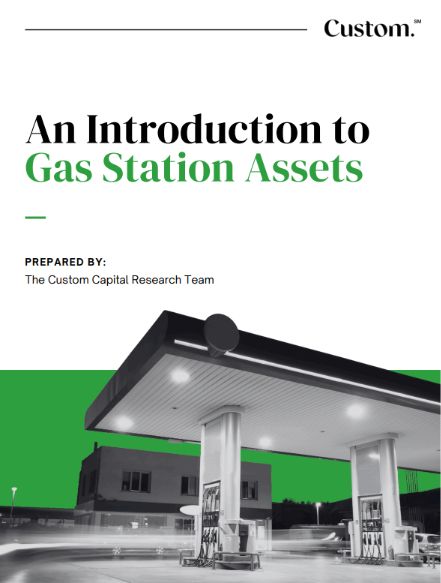
Gas Station Real Estate Overview
The combined convenience store and gas station market reached nearly $755 billion in total sales in 2024, and that figure encompasses over 152,000 convenience stores nationwide, roughly 80% of which sell fuel. The U.S. gas station industry, excluding locations with convenience stores, generates approximately $120–135 billion in annual revenue.
At its core, gas station real estate refers to properties where fuel is sold to drivers, often alongside convenience retail. Unlike office buildings or luxury retail centers, these facilities exist because people need to get somewhere and, in order to do that, they need to refuel the vehicle that gets them to that place.
The asset class covers four main categories: convenience store gas stations (the most common format, typically under long NNN leases to experienced operators), travel centers and truck stops (larger highway-oriented facilities like Pilot Flying J and Love’s), fuel kiosks and smaller stations (operated by warehouse clubs or independent operators), and new hybrid models that combine fueling with quick-serve restaurants and foodservice.

Despite the variety, all subtypes share a common foundation: they serve demand that exists because people need to move and access daily essentials.
Four Macroeconomic Trends Driving Demand
Investing in gas station real estate means investing in the enduring reality of America’s car-centric culture. Here are the four structural trends that matter most right now.
1. Driving Demand Remains Resilient
Vehicle Miles Traveled (VMT) hit an all-time high in 2025 at 3.32 trillion miles. About 279 million vehicles are registered in the United State, roughly one for every adult. Decades of suburban expansion and infrastructure investment have entrenched personal vehicles as the default mode of transportation. Even with ridesharing and remote work trends, Americans are driving more total miles than ever before.
2. EV Adoption is Not Widespread
Electric vehicles get a lot of headlines, but the transition away from combustion engines is slow by any honest measure. Only about 10% of new car sales in the U.S. are electric, a figure that has essentially plateaued since 2023. The average car stays on the road over 12 years, meaning hundreds of millions of gas-powered vehicles will remain in service through the 2030s. Each one will continue needing fuel.
3. EV Incentives Are Disappearing
EV adoption depends heavily on government subsidies. When those subsidies disappear, so does consumer enthusiasm. At the beginning of this year, we reported that Germany’s EV sales plunged 27% in 2024 after the government scrapped buyer incentives. We predicted a similar slowdown in EV adoption in the US, and that appears to have been borne out by the data: US EV sales have also plunged 28% in Q1 of 2026.
4. Industry Consolidation Is Producing Stronger Tenants
The gas station industry has historically been fragmented, two-thirds of the market is still “mom-and-pop” single-unit operators. But M&A activity is accelerating. Major examples include BP’s $1.3B acquisition of TravelCenters of America and 7-Eleven’s $21B purchase of Speedway’s 3,800 stores. For real estate investors, consolidation is a tailwind: corporate tenants mean stronger lease guarantees, lower default risk, and more predictable renewals.
Why Gas Station Real Estate Works Well for Direct Ownership (#1 Reason: Depreciation Benefits)
For investors seeking durable, long-term income, gas station real estate has several structural advantages over traditional commercial property types.
Significant depreciation advantages. Gas stations often qualify for accelerated depreciation under IRS rules. Many meet the definition of a “retail motor fuel outlet,” allowing the building and its improvements to be depreciated over 15 years instead of the standard 39. Combined with cost segregation, which can reclassify 50–80% of a gas station’s depreciable basis into shorter-lived property categories, gas station assets can generate meaningfully larger upfront tax deductions than most other commercial real estate types. (Investors should consult their CPA for tax advice.)
Long-term leases with NNN structures. Most gas station properties are leased on a triple-net basis, often with 15–20 year initial terms and options extending 20–30 years out. The NNN structure means tenants pay property taxes, insurance, and maintenance, keeping the owner’s net income predictable and management burden minimal.
Essential service with structural demand. Virtually everyone who drives a car needs fuel. This demand isn’t tied to fads, technology cycles, or consumer sentiment. It’s rooted in the daily rhythms of commuting, commerce, and travel.
Inflation alignment and durable land value. Gas station sites are typically high-traffic corner lots or highway parcels with intrinsic land value that persists regardless of what sits on them. In an inflationary environment, replacement costs for new stations rise, creating high barriers to new competition. Many leases include built-in rent escalations, keeping the income stream protected in real terms.
Portfolio diversification. Gas station assets behave differently from office buildings, apartments, or retail centers. Their cycles and risk drivers are distinct, which can smooth overall portfolio returns. And unlike major office or industrial properties that often require tens of millions to access, many gas station deals trade in the few-million-dollar range, accessible to individual investors without institutional scale.
The Risks You Should Understand
Investing in gas station real estate is not without risk, and informed investors underwrite accordingly.
Tenant and credit risk. Gas stations operate on thin fuel margins. If a tenant’s supply contract becomes uneconomical or a competitor opens nearby, a weaker operator could struggle and re-tenanting a specialized property takes longer than re-tenanting general retail.
Environmental and regulatory risk is ever-present. Every gas station comes with underground storage tanks and the inherent risk of fuel leakage. Environmental contamination can involve costly remediation. Modern double-walled tanks and monitoring systems greatly reduce this risk, but older stations may carry legacy issues. Well-crafted leases assign environmental responsibility to the tenant and require pollution liability insurance, making this a manageable consideration.
Market and location risk exists. A gas station’s success depends heavily on traffic counts, accessibility, visibility, and local competition. If a once-busy road is bypassed by a new highway, volumes can plummet. Rigorous due diligence on location fundamentals is non-negotiable.
But What About EVs?
It’s one of the first questions every new gas station investor asks. If EVs explode in popularity, gas station demand is sure to go down. While we touched on this earlier in the article, it’s an important point to reiterate (especially for readers who are just skimming).
The simple truth is this: Electric vehicles are not going away, but they’re also not replacing gas stations anytime soon.
New EV sales in the U.S. were down 28% in Q1 of 2026 compared to the same period a year earlier, following the expiration of federal purchase incentives. Even amidst the Iran War (pushing gas prices in the US up by about 38%, this hasn’t been enough for consumers to consider buying a new EV; although that article notes that used EV sales have ticked up a bit).
Even that overstates the near-term impact on fuel demand: As we mentioned earlier, over 97% of cars currently on the road are gas-powered, and the average vehicle stays in service for more than 12 years.
The bottom line: the vast majority of Americans still drive gas-powered cars, still need to fill up, and will continue doing so for decades.
The EV transition is measured in generations and for gas station real estate investors, the demand runway remains long.
5 Key Takeaways for Investors in Gas Station Real Estate
- Fuel demand is non-discretionary.
- Americans drive because they have to and gas stations sit at the intersection of that necessity and daily convenience.
- Driving volumes hit an all-time high in 2025 despite years of EV headlines and remote work trends.
- EV adoption is far slower than popular narratives suggest, and the disappearance of federal incentives may slow it further.
- Industry consolidation is creating a stronger tenant base, which is a meaningful positive for landlords. And the combination of long NNN leases, accelerated depreciation, and structural demand makes gas station real estate a uniquely favorable asset class for direct ownership.
Final Thought
Investing in gas station real estate is about underwriting fundamentals that persist regardless of what’s happening in the broader market: non-discretionary demand, essential infrastructure, resilient driving culture, and an asset class that evolves with the times rather than disappearing because of them.
For investors seeking potential long-duration cash flow, operational simplicity, and alignment with the unavoidable reality that people need to get where they’re going, gas station real estate earns its place as a core component of a thoughtfully constructed real asset portfolio.
If you’re interested in investing with Custom Capital, click here for more information.
This post is provided for informational and educational purposes only and does not constitute investment, legal, or tax advice. All investments involve risk. Outcomes vary and are not guaranteed.